
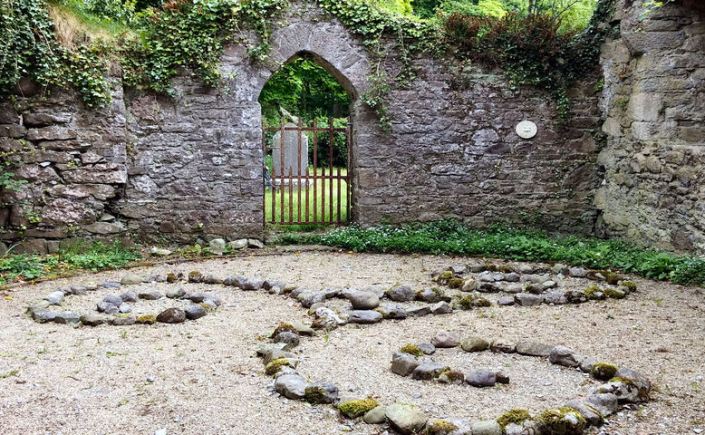
Where does this leave secular societies in which technological or policy-focused solutions to environmental problems are not working, but where identification with the sacred has waned over time? Can something as deeply personal and experiential as the sacred be meaningfully shaped by design? Could mundane, often thankless tasks — cycling, tree-planting, recycling — be reframed not as chores, but as rituals of care and connection that inspire deeper commitment to environmental stewardship?
The sacred need not be confined to formal religion. While the Grand Bassin’s significance is rooted in Hindu mythology and practice, the orientation it reflects — a sense of reverence, moral weight and emotional resonance — can arise in many forms. Sacredness emerges wherever people set something apart as meaningful beyond its utility: a forest grove, a war memorial, a national flag, a moment of collective silence. What matters is not the doctrine behind it but the way it shapes how people think, feel and act.
Of course, one might ask whether it’s even possible to promote rituals of care in the absence of care itself. Wouldn’t such efforts ring hollow or fail to resonate with those who feel disconnected from the natural world in the first place? But this is precisely where sacralization matters most. Sacredness does not only emerge from what people already revere — it actively helps generate that reverence. Rituals can bring people into a different frame of mind, one in which meaning accumulates through repetition, symbols take on weight and ordinary acts begin to feel purposeful. If environmental stewardship is to take root, it may not be enough to wait for people to care. Sometimes the path to care begins with practice.
“Simply being in a setting marked as sacred seems to trigger a shift in moral orientation, nudging people toward more prosocial behavior.”
— Dimitris Xygalatas, “To Save Nature, Make It Sacred”
We currently conduct a full worship service on the first Sunday of each month, and discuss a different short reading each of the remaining Sundays.
On Sunday, 13 Julye, we will open with a very brief service and chalice lighting, followed by our discussion. Robert Helfer will lead the service and discussion. This week’s reading is “To Save Nature, Make It Sacred”, by Dimitris Xygalatas, Noēma, July 3, 2025.
“To Save Nature, Make It Sacred”, can be found here.
Our services are Sundays at 10:30 a.m. Eastern Time on ZOOM and in person at the Progressive Women’s Association Event Center, 305 Washington Ave. in downtown Clarksburg, behind the Courthouse. A coffee hour, a time for discussion and socializing (including ZOOM participants), follows from the end of the service until 12:00 noon. More about us.
If you prefer not to be seen, video is optional. If you would like to participate online, please email westforkuu@gmail.com for details and a link, or for help with using ZOOM.
We would love to have you come worship with us.
Children are welcome. There are activities available for toddlers during the service.
The building is wheelchair accessible, with an accessible restroom. You may park on the south side of the building, which is marked reserved for the PWA, or the north, where the reserved spaces are available on Sundays.
Email westforkuu@gmail.com or use our contact form for more information or write to us at PO Box 523, Clarksburg WV 26302
 West Fork Unitarian Universalists