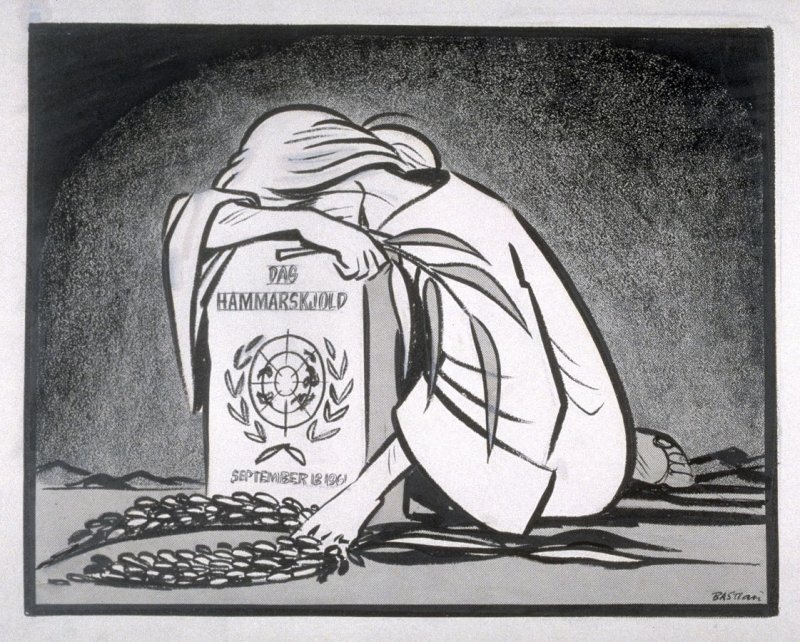
You wake from dreams of doom and — for a moment — you know: beyond all the noise and the gestures, the only real thing, love’s calm unwavering flame in the half-light of an early dawn.
— Dag Hammarskjöld, Markings, translated by Leif Sjöberg & W.H. Auden
On 18 September 1961, Dag Hammarskjöld, second Secretary-General of the United Nations, died when the airplane he was in crashed in what was then Northern Rhodesia (now Zambia). He was traveling to negotiate a cease-fire in a conflict in the Republic of the Congo.
Tonight is the first evening of Rosh Hashanah which begins at sundown. For Jews it is Yom Teruah, the Day of Shouting (or Blasting) which marks the first of the High Holy Days as well as the start of the New Year. It falls on the first day of Tishrei, the seventh month of the ecclesiastical year that began with Passover in the spring and represents the first of the civic year. This year it ushers in 5784 on the Hebrew calendar.
May the joyful noise of the shofar announce the new year for all our Jewish friends.
Ray Bradbury’s short story “There Will Come Soft Rains — August 4, 2026” from The Martian Chronicles reflects the day before the 80th anniversary of the bombing of Hiroshima in 1945. This version from BBC Radiophonic Workshop, 1977, titled “August 2026: There Will Come Soft Rains”, was adapted for “Narrator, Vocoder and Synthesizer” by Malcolm Clarke.
Someone’s comment on the YouTube page for a different version provides some context:
This Ray Bradbury story is an anti-war message, as is the Sara Teasdale poem with the same title. However, the full title of the story in The Martian Chronicles is “There Will Come Soft Rains — August 4, 2026”. On August 5, 1945 (US time), the USA dropped a nuclear bomb on Hiroshima. August 4, 2026 marks the end of a full 80 years after the bombing. The destroyed house repeating “Today is August 5, 2026” endlessly is a warning of what happened when we forgot Hiroshima 81 years before. Bradbury wrote the story in 1950, just after the Soviet Union first successfully tested a nuclear bomb in 1949. The story was right for its time as it is today. It is about what a Cold War brings when it gets hot.
Sara Teasdale wrote her poem around 1918 during a time of total war and pandemic. Perhaps the poem still has something to say to us in our current condition.
(War Time)
There will come soft rains and the smell of the ground, And swallows calling with their shimmering sound;
And frogs in the pools singing at night, And wild plum-trees in tremulous white;
Robins will wear their feathery fire Whistling their whims on a low fence-wire;
And not one will know of the war, not one Will care at last when it is done.
Not one would mind, neither bird nor tree If mankind perished utterly;
And Spring herself, when she woke at dawn, Would scarcely know that we were gone.
I long to hear that you have declared an independency. And by the way, in the new Code of Laws which I suppose it will be necessary for you to make I desire you would Remember the Ladies, and be more generous and favourable to them than your ancestors. Do not put such unlimited power into the hands of the Husbands. Remember all Men would be tyrants if they could. If particular care and attention is not paid to the Ladies we are determined to foment a Rebellion, and will not hold ourselves bound by any Laws in which we have no voice, or Representation.
— Abigail Adams, Letter to John Adams (31 March 1776)
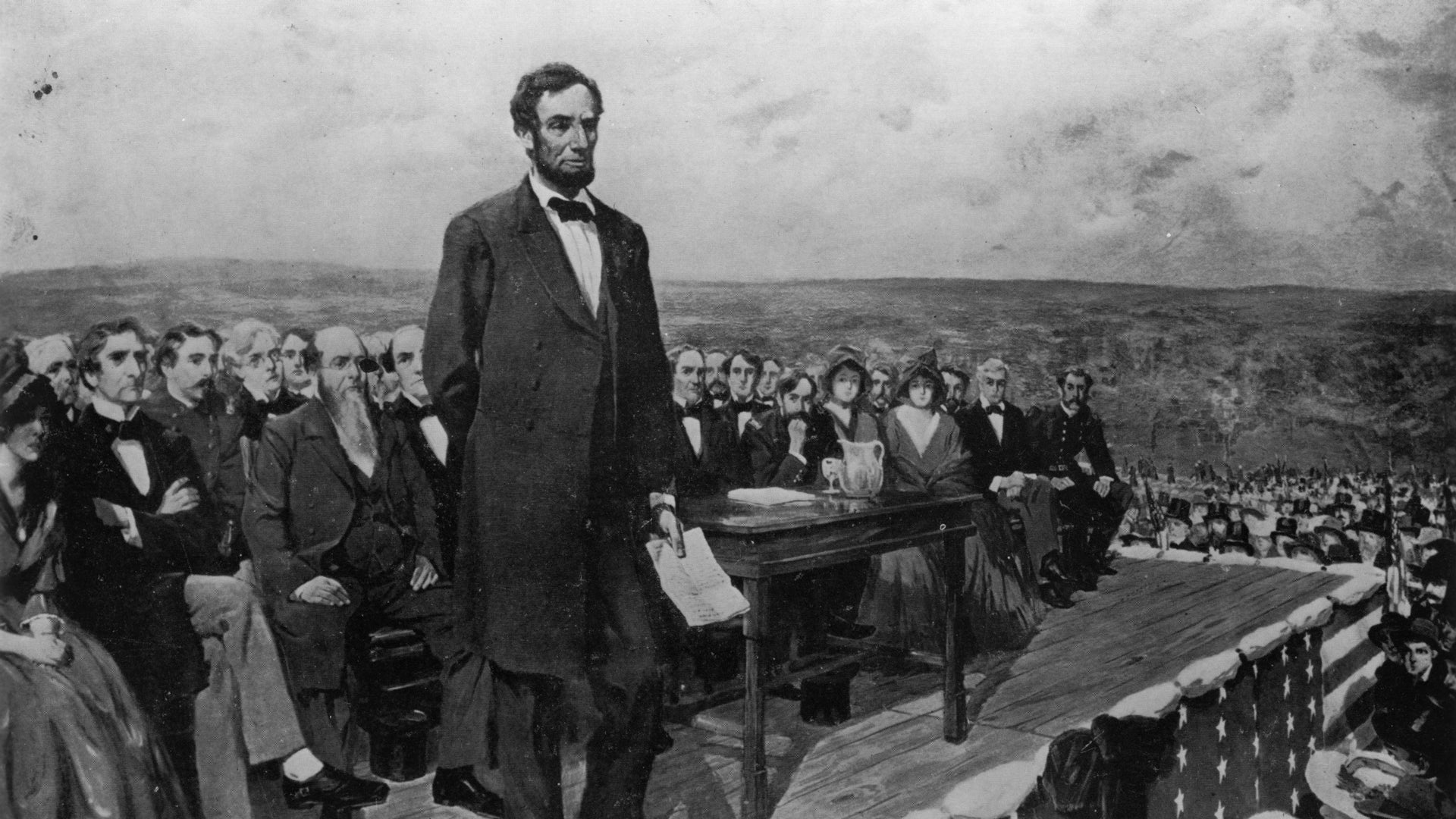
The most intelligent and decent prayers ever uttered by a famous American, addressed To Whom It May Concern, and following an enormous man-made calamity, were those of Abraham Lincoln at Gettysburg, Pennsylvania, back when battlefields were small. They could be seen in their entirety by men on horseback atop a hill. Cause and effect were simple. Cause was gunpowder, a mixture of potassium nitrate, charcoal, and sulfur. Effect was flying metal. Or a bayonet. Or a rifle butt.
Abraham Lincoln said this about the silenced killing grounds at Gettysburg:
“We cannot dedicate — we cannot consecrate — we cannot hallow this ground. The brave men, living and dead, who struggled here have consecrated it far above our poor power to add or detract.”
Poetry! It was still possible to make horror and grief in wartime seem almost beautiful. Americans could still have illusions of honor and dignity when they thought of war. The illusion of human you-know-what. That is what I call it: “The you-know-what.”
— Kurt Vonnegut, A Man Without a Country (2005)
The Battle of Gettysburg took place July 1-3, 1865, in and around the town of Gettysburg, Pennsylvania. Gettysburg is considered to have been the deadliest battle of the US Civil War.
The battlefield became the Soldiers’ National Cemetery. Abraham Lincoln delivered his famous “Gettysburg Address“, which Vonnegut cites above, at the cemetery’s dedication on November 19, 1865.
I believe in the existence of a universe of suns and planets, among which there is one sun belonging to our planetary system; and that other suns, being more remote, are called stars; but that they are indeed suns to other planetary systems. I believe that the whole universe is NATURE, and that the word NATURE embraces the whole universe, and that God and Nature, so far as we can attach any rational idea to either, are perfectly synonymous terms. Hence I am not an Atheist, but a Pantheist; that is, instead of believing there is no God, I believe that in the abstract, all is God; and that all power that is, is in God, and that there is no power except that which proceeds from God. I believe that there can be no will or intelligence where there is no sense; and no sense where there are no organs of sense; and hence sense, will, and intelligence, is the effect, and not the cause, of organization. I believe in all that logically results from these premises, whether good, bad, or indifferent. Hence, I believe, that God is all in all; and that it is in God we live, move, and have our being; and that the whole duty of man consists in living as long as he can, and in promoting as much happiness as he can while he lives.
— Abner Kneeland, “A Philosophical Creed,” written at Hebron, N.H., May 28, 1833, Boston Investigator, July 12, 1833
Abner Kneeland (April 7, 1774-August 27, 1844), a pioneer evangelist and minister, was a powerful, if inconsistent, advocate of Universalism for a quarter of a century beginning with the Winchester Convention of 1803. His religious doubts and ever-changing theology posed challenges to his Universalist friends and colleagues. Ultimately he was led beyond Christianity. After he left the Universalist fellowship he became the last man to be convicted of blasphemy in the state of Massachusetts. Clinton Lee Scott wrote that Kneeland was “the most controversial character ever ordained to the Universalist ministry. He anticipated by a century opinions now held without opposition.”
Midsummer is when the Cosmos is holding and supporting us, when we’re allowed to release anything we’ve been keeping in. What creative venture is waiting to burst forth? What can you continue to nurture in the next season?
The people are informed that in accordance with a Proclamation from the Executive of the United States, all slaves are free. This involves an absolute equality of personal rights and rights of property, between former masters and slaves, and the connection heretofore existing between them, become that between employer and hired labor. The freed are advised to remain at their present homes, and work for wages. They are informed that they will not be allowed to collect at military posts; and that they will not be supported in idleness either there or elsewhere.
— General Gordon Granger, “General Order No. 3“, June 19, 1865, Galveston, Texas
“Faith must not be blind, but responsible. We ought not to be mentally coerced, but rationally convinced, so that we can make a justifiable decision of faith. Faith must not be void of reality, but related to reality. We ought not to have to believe simply, without verification. Our statements should be proved and tested by contact with reality, within the present-day horizon of experience of individuals and society, and thus be covered by the concrete experience of reality.”
“Faith must not be blind, but responsible. We ought not to be mentally coerced, but rationally convinced, so that we can make a justifiable decision of faith. Faith must not be void of reality, but related to reality. We ought not to have to believe simply, without verification. Our statements should be proved and tested by contact with reality, within the present-day horizon of experience of individuals and society, and thus be covered by the concrete experience of reality.”