Another story honoring Mister Rogers.
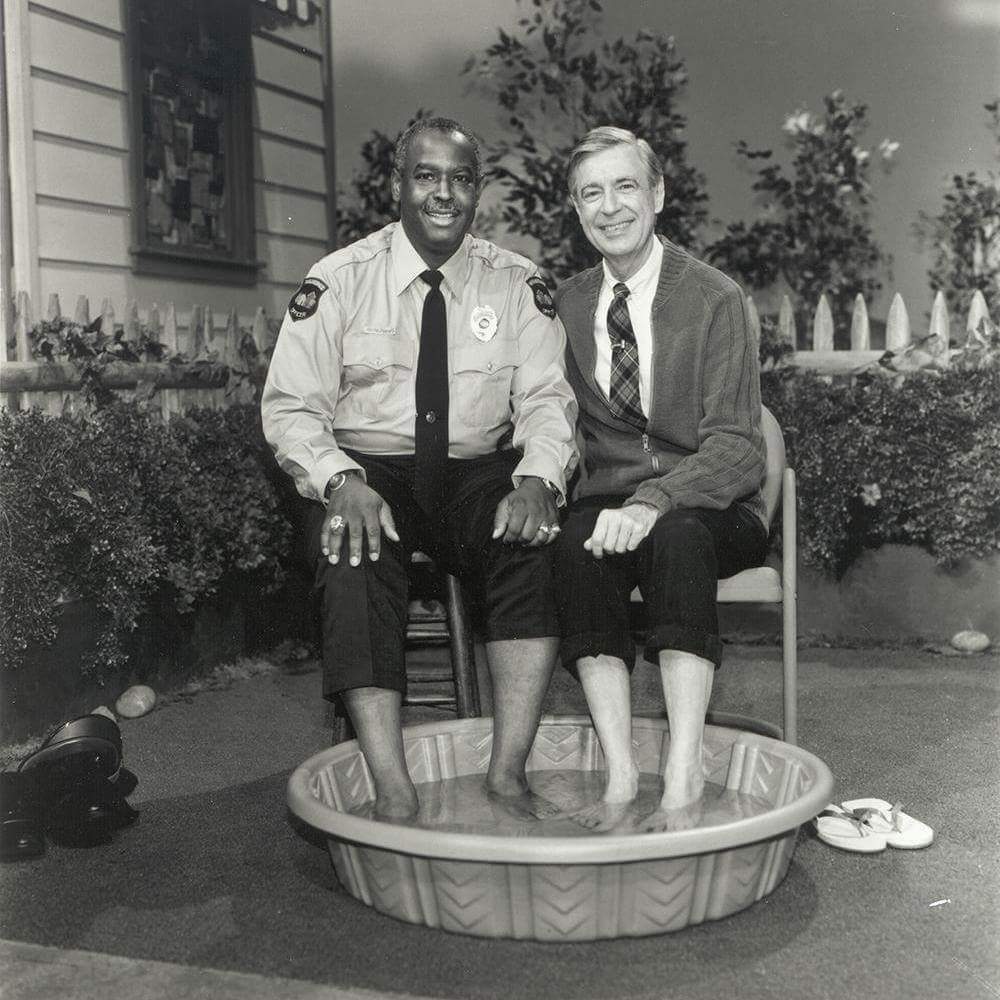
Several friends have shared this photo of Mister Rogers and Officer Clemmons cooling their feet together in a pool, and I wanted to learn more about it, especially on this day, the first day of Spring, which also happens to be Fred Rogers’ birthday.
Several months after Dr. Martin Luther King, Jr. was assassinated, when riots were erupting in black neighborhoods across the nation, Fred Rogers approached Francois Clemmons after hearing him sing in a church. He asked him to join him on his show, to be a police officer, which was a radical idea at that time – a black police officer keeping families safe in the Neighborhood.
Clemmons would remember:
“I grew up in the ghetto. I did not have a positive opinion of police officers. Policemen were siccing police dogs and water hoses on people. And I really had a hard time putting myself in that role. So I was not excited about being Officer Clemmons at all.”
But, he trusted Fred Rogers, and in August 1968, Francois Clemmons debuted as Officer Clemmons on Mister Rogers’ Neighborhood (MRN). He would become the first African-American to have a recurring role on a kids TV series, and he would continue to have that role for the next 25 years.
Which brings us to the famous scene. It was 1969, shortly after the first anniversary of the assassination of Dr. King, when Mister Rogers on a hot day invited Officer Clemmons to join him in soaking his feet in a wading pool.
Clemmons remembers: “He invited me to come over and to rest my feet in the water with him.” He continued, with emotion, “The icon Fred Rogers not only was showing my brown skin in the tub with his white skin as two friends, but as I was getting out of that tub, he was helping me dry my feet.”
Many people saw this as a symbolic message from Mister Rogers, a radical idea at the same time when the news also featured a white man throwing acid into a “whites only” motel pool to rid the pool of black swimmers.
But, it wasn’t anything new for Mister Rogers. When the show went national in 1979, when a white backlash against the civil rights movement was occurring, Mister Rogers received a visit at home from Mrs. Saunders, an African American teacher, and a small interracial group of her students, showing that at least in this Neighborhood, white and black neighbors can live peacefully together.
In 1975, Mister Rogers would also introduce Mayor Maggie, a character played by African American actor Maggie Stewart, who would become King Friday’s political equal and even had the assistance of a white underling, Associate Mayor Aber (played by the blond and blue-eyed Chuck Aber).
Years later, in 1993, Officer Clemmons would make his last appearance on MRN, and, in a touching moment, Mister Rogers would again invite Officer Clemmons, again joining Rogers at a wading pool in the front yard. This time, two grown men, one white, one black, as they soaked their feet together, discussed and sang a song about the different ways people say “I love you.”
Clemmons would remember that the scene touched him in a way he hadn’t expected.
As they said their goodbyes, with Mister Rogers thanking Officer Clemmons for joining him, Officer Clemmons would emotionally respond, thanking Mister Rogers and saying:
“I like being a human being right here and now.”




 4) Fables should be taught as fables, myths as myths, and miracles as poetic fancies. To teach superstitions as truths is a most terrible thing. The child mind accepts and believes them, and only through great pain and perhaps tragedy can he be in after years relieved of them.
