“Dávid Ferenc” (@unitariandavidferenc) posted this last year on Facebook:
On this date, January 6, in 1568 king John Sigismund assembled a Diet to be held in the town Torda (today Turda in Romania). At this Diet our Bishop Dávid Ferenc (Francis David) inspired the delegates to later approve the first toleration edict of freedom of faith among the Christian religions.
This was a new and revolutionary idea of freedom of religion at that time, and therefore January 6 1568 also is considered by tradition to be the birth of The Unitarian Church.
Persons identified in the famous painting by Aladár Körösfői-Kriesch showing Bishop Francis David at the Diet of Torda 1568.
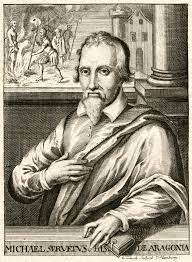
On this date, 27 October 1553, Michael Servetus, physician and theologian, was burned at the stake in Geneva, Switzerland, for the crime of rejecting the doctrine of the Trinity. He was the first European to describe pulmonary circulation. The description, unnoticed by any of the heretic hunters who examined Servetus’ works, was hidden in the book that Calvin ordered to be burned along with Servetus himself.
A useful summary of Servetus’ life, works, and death, as well as a list of his works, can be found at the Michael Servetus Institute web site. Fuller descriptions of Servetus’ life, works, trial, and execution can be found in Lawrence and Nancy Goldstone, Out of the Flames: The Remarkable Story of a Fearless Scholar, a Fatal Heresy, and One of the Rarest Books in the World, or Roland H. Bainton, Hunted Heretic: The Life and Death of Michael Servetus, 1511-1553.
On this date, 27 October 1553, Michael Servetus, physician and theologian, was burned at the stake in Geneva, Switzerland, for the crime of rejecting the doctrine of the Trinity. He was the first European to describe pulmonary circulation. The description, unnoticed by any of the heretic hunters who examined Servetus’ books, was hidden in the book that Calvin ordered to be burned along with Servetus himself.
A useful summary of Servetus’ life, works, and death, as well as a list of his works, can be found at the Michael Servetus Institute web site. Fuller descriptions of Servetus’ life, works, trial, and execution can be found in Lawrence and Nancy Goldstone, Out of the Flames: The Remarkable Story of a Fearless Scholar, a Fatal Heresy, and One of the Rarest Books in the World, or Roland H. Bainton, Hunted Heretic: The Life and Death of Michael Servetus, 1511-1553.
“Dávid Ferenc” (@unitariandavidferenc) posted this earlier today (6 January 2024) on Facebook:
456 years ago today:
On this date, January 6, in 1568 king John Sigismund assembled a Diet to be held in the town Torda (today Turda in Romania). At this Diet our Bishop Francis David inspired the delegates to later approve the first toleration edict of freedom of faith among the Christian religions.
This was a new and revolutionary idea of freedom of religion at that time, and therefore January 6 1568 also is considered by tradition to be the birth of The Unitarian Church.
Persons identified in the famous painting by Aladár Körösfői-Kriesch showing Bishop Francis David at the Diet of Torda 1568.
On this date, 27 October 1553, Michael Servetus, physician and theologian, was burned at the stake in Geneva, Switzerland, for the crime of rejecting the doctrine of the Trinity. He was the first European to describe pulmonary circulation. The description, unnoticed by any of the heretic hunters who examined Servetus’ books, was hidden in the book that Calvin ordered to be burned along with Servetus himself.
A full description of Servetus’ trial and execution can be found in Lawrence and Nancy Goldstone, Out of the Flames: The Remarkable Story of a Fearless Scholar, a Fatal Heresy, and One of the Rarest Books in the World, or Roland H. Bainton, Hunted Heretic: The Life and Death of Michael Servetus, 1511-1553.
On this date, 27 October 1553, Michael Servetus, physician and theologian, was burned at the stake in Geneva, Switzerland, for the crime of rejecting the doctrine of the Trinity. He was the first European to describe pulmonary circulation. The description, unnoticed by any of the heretic hunters who examined Servetus’ books, was hidden in the book that Calvin ordered to be burned along with Servetus himself.
A full description of Servetus’ trial and execution can be found in Lawrence and Nancy Goldstone, Out of the Flames: The Remarkable Story of a Fearless Scholar, a Fatal Heresy, and One of the Rarest Books in the World, or Roland H. Bainton, Hunted Heretic: The Life and Death of Michael Servetus, 1511-1553.
The primary benefit of practicing any art, whether well or badly, is that it enables one’s soul to grow.
— Kurt Vonnegut
Worship, simply put, is an art, one that Unitarians and Universalists have sometimes failed to understand. This Sunday Robert Helfer will explore some of the history of Unitarian Universalist worship and spirituality.
Our services are Sundays at 10:30 a.m. at the Progressive Women’s Association Event Center, 305 Washington Ave. in downtown Clarksburg, behind the Courthouse. A coffee hour, a time for discussion and socializing, will follow from the end of the service until 12:00 noon.
Classes and worship are replaced by Spiritual Outings on the first Sunday of each month during the summer, with brief worship, a potluck picnic, and outdoor activities. The schedule is in the sidebar.
We would love to have you come worship with us.
Children are welcome.
The building is wheelchair accessible, with an accessible restroom.
I vow to refrain from all evil. I vow to make every effort to live in enlightenment. I vow to live and be lived for the benefit of all beings.
– from the Sixteen Bodhisattva Precepts
Buddhist psychology teaches that intention is what makes the pattern of our karma. Karma, the cause and results of every action, comes from the heart’s intentions and precede each action. When our intentions are kind, the karmic result is very different from when they are greedy or aggressive. If we are not aware, we will unconsciously act out of habit and fear. But if we attend to our intentions, we can notice if they spring from the body of fear or from our deliberate thoughtfulness and care.
– Jack Kornfeld, After the Ecstasy, the Laundry
The second UU Principle is “Justice, equity and compassion in human relations” and the second step of the Buddhist Eightfold Path is Right Intention. Lisa deGruyter will lead the service.
Please Join Us for Worship.
We are forgoing meeting in person during the coronavirus epidemic, meeting on Zoom. We share music, readings, and hymns on our usual presentation slides, have a story and a talk, and share joys and sorrows, as well as a virtual “coffee hour” discussion starting at 10:30, with the service at 11. If you prefer not to be seen, video is optional. If you would like to participate, please email westforkuu@gmail.com for details and a link, or for help with using ZOOM.
If you are a regular attendee, we have added you to our Google Group if we had an email address. If you have not gotten a group email already, please email westforkuu@gmail.com so that we can add you to the group, which we will be using for staying in touch with each other during this time. Public announcements will continue to be posted here on the website and on our Facebook page and Twitter account, as usual.
Email westforkuu@gmail.com or use our contact form for more information or write to us at PO Box 523, Clarksburg WV 26302
If you missed our service for 16 January 2022 on the value of remembering our Unitarian Universalist past, it has been updated with full music and text and can be seen here:




 West Fork Unitarian Universalists