
http://growinguu.blogs.uua.org/spiritual-vitality/dinner-church/
“Dinner church is a deeply communal form of worship, one that allows people to interact with one another in a fairly casual and yet deeply sacred setting.”
~
Namaste
Cricket
UU thoughts, sermons, music
http://growinguu.blogs.uua.org/spiritual-vitality/dinner-church/
“Dinner church is a deeply communal form of worship, one that allows people to interact with one another in a fairly casual and yet deeply sacred setting.”
~
Namaste
Cricket
I’ll begin with a little bit of my own history, talk briefly about the sorts of things we share in common with Catholicism that you’ll often hear me preach about, and then move onto the areas where we could do better in following some of Catholicism’s strengths that are in line with our values – but where we may not currently do so well

The more you can free yourself from your internalization of the gaze of others, the more liberated you feel. As you bring more humor to issues of the body’s appearance, the more you will unleash the healthy energies of the mind.
Under Your Skin: A Thai forest monk explains why a healthy body image is not what you think it is.
We will be discussing the ideas in this article; reading it beforehand is optional, but helpful.
http://www.uua.org/worship/words/opening/your-body-welcome-here
With all of the body shaming and bathroom wars, sometimes we need to take a moment to step back and remember that that we are who we are and we are loved.
Namaste,
Cricket
In my view the critical work of religion is fostering the quest for meaning in the face of our fragile lives caught up in forces greater than any of us. This world we live in is filled with hurt and violence and every imaginable cruelty. It breaks the heart. And. This world is also so astonishingly beautiful and precious and run through with the mysteries of love and compassion, that it can take our breath away. This strange mix is what we actually encounter in the world. The work of religion is squaring that circle, finding our place in the great mess. And it is unspeakably important.
Another fine sermon from James Ishmael Ford

Arriving at “truth” merely means you’ve given up the search. Science is open-ended; philosophy is open-ended; all the fine arts are open-ended—this is what creativity is, when every new thing is new. As in art and science and philosophy, stopping the search in religious thinking means you’ve given up any hope of renewal, or creativity.
Religious thinking—thinking about the ultimate meaning and purpose of human life on this planet—must involve both the chance to continuously evolve with time and must offer some hope for the human condition—our condition—itself.
The “Trinsics”: Where are You Coming From? http://www.patheos.com/blogs/uucollective/2015/11/the-trinsics-where-are-you-coming-from/

Today is Good Friday. For our Christian friends this is a day of remembrance, meditation, and focusing on the dark times. Holy Week is in many ways the spiritual embodiment of the turn from Winter into Spring. It is about how the darkness is necessary to bring the light.
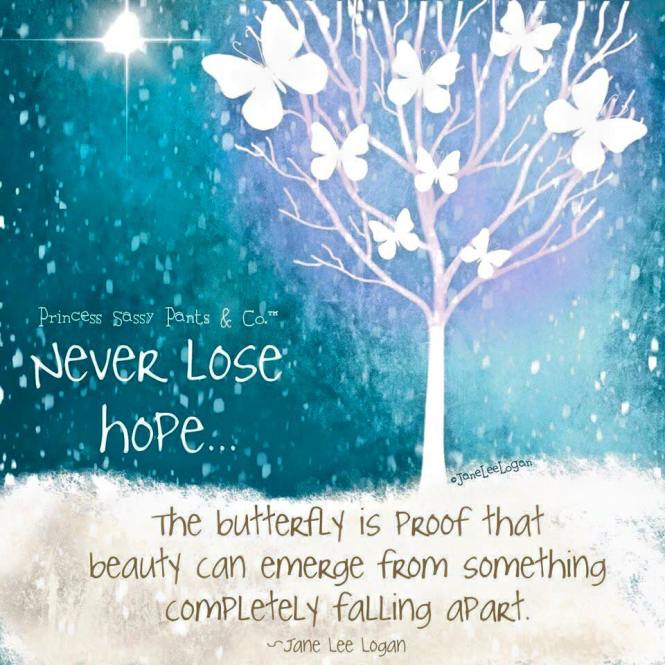
This theme of coming through the darkness and into the light as a better version of one’s self is a theme through many religions. The winter is often dark and brooding. We suffer through the cold and dark, not realizing what it does to us. We don’t always see the work that we do within our spirit during that time, whether it is the actual season or a dark time in our lives. When Spring returns we rejoice and dance. We often do not see the transformation in ourselves. For those who are in a dark time, the picture below helped me a lot and I hope it helps you as well. Spring is just around the corner.
Spring and Easter are often billed as for the children. I think it is because they get a lot of joy out of the season. I found a page that has 25 butterfly crafts and one that has 15 indoor/outdoor activities for spring. Yes, they are designed for children, but they are also designed for parents or grandparents to do with the children. Sometimes doing crafts can be a very meditative process. For those that prefer coloring here is a butterfly mandala to color. I hope that these simple things will bring you joy. Perhaps they can help you find the light in your dark time. Perhaps they can help you realize the growth you have made. Perhaps they will just bring you joy and that is all I wish for anyone.
Namaste,
Cricket
An interview with UU minister Rev. Erik Martínez Resly “an interfaith child who grew up to become an inspired community leader” and Lead Organizer of The Sanctuaries, a racially and religiously diverse arts community in Washington, DC.
http://www.huffingtonpost.com/susan-katz-miller/when-interfaith-kids-grow_b_8959626.html
Another story honoring Mister Rogers.
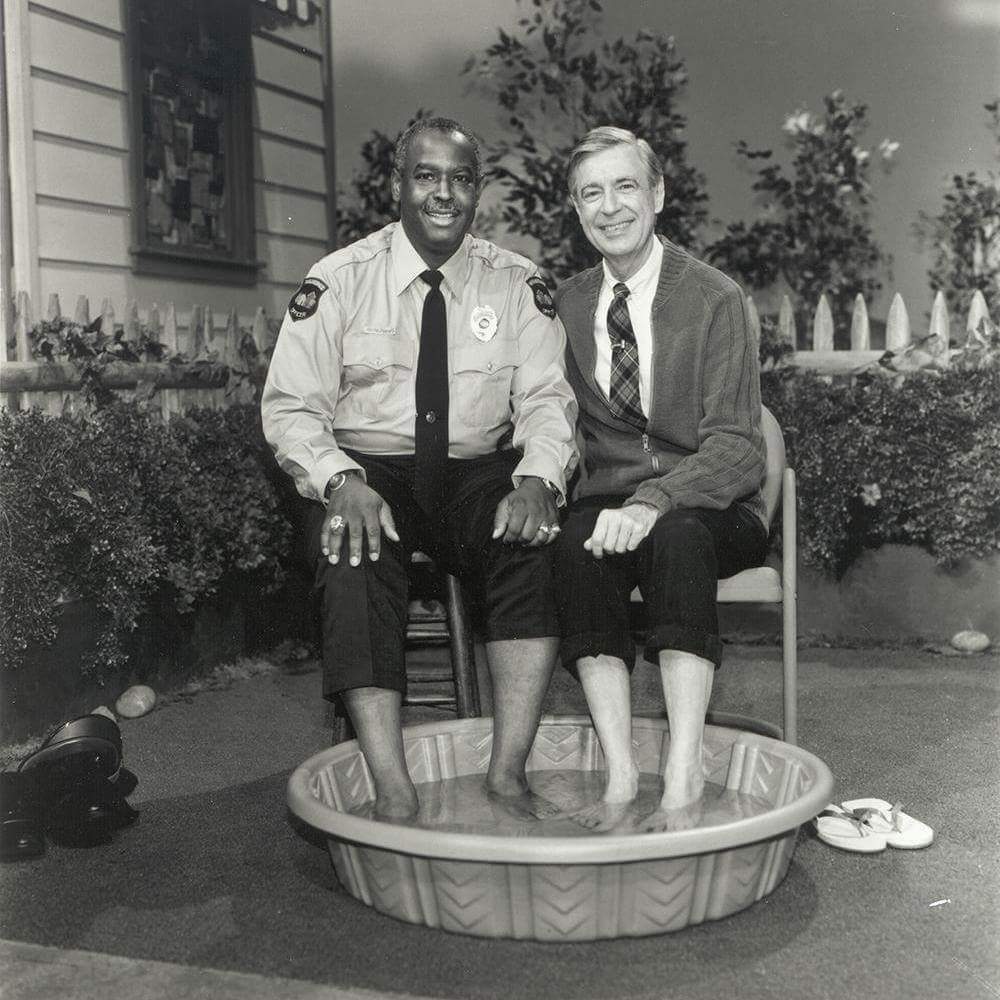
Several friends have shared this photo of Mister Rogers and Officer Clemmons cooling their feet together in a pool, and I wanted to learn more about it, especially on this day, the first day of Spring, which also happens to be Fred Rogers’ birthday.
Several months after Dr. Martin Luther King, Jr. was assassinated, when riots were erupting in black neighborhoods across the nation, Fred Rogers approached Francois Clemmons after hearing him sing in a church. He asked him to join him on his show, to be a police officer, which was a radical idea at that time – a black police officer keeping families safe in the Neighborhood.
Clemmons would remember:
“I grew up in the ghetto. I did not have a positive opinion of police officers. Policemen were siccing police dogs and water hoses on people. And I really had a hard time putting myself in that role. So I was not excited about being Officer Clemmons at all.”
But, he trusted Fred Rogers, and in August 1968, Francois Clemmons debuted as Officer Clemmons on Mister Rogers’ Neighborhood (MRN). He would become the first African-American to have a recurring role on a kids TV series, and he would continue to have that role for the next 25 years.
Which brings us to the famous scene. It was 1969, shortly after the first anniversary of the assassination of Dr. King, when Mister Rogers on a hot day invited Officer Clemmons to join him in soaking his feet in a wading pool.
Clemmons remembers: “He invited me to come over and to rest my feet in the water with him.” He continued, with emotion, “The icon Fred Rogers not only was showing my brown skin in the tub with his white skin as two friends, but as I was getting out of that tub, he was helping me dry my feet.”
Many people saw this as a symbolic message from Mister Rogers, a radical idea at the same time when the news also featured a white man throwing acid into a “whites only” motel pool to rid the pool of black swimmers.
But, it wasn’t anything new for Mister Rogers. When the show went national in 1979, when a white backlash against the civil rights movement was occurring, Mister Rogers received a visit at home from Mrs. Saunders, an African American teacher, and a small interracial group of her students, showing that at least in this Neighborhood, white and black neighbors can live peacefully together.
In 1975, Mister Rogers would also introduce Mayor Maggie, a character played by African American actor Maggie Stewart, who would become King Friday’s political equal and even had the assistance of a white underling, Associate Mayor Aber (played by the blond and blue-eyed Chuck Aber).
Years later, in 1993, Officer Clemmons would make his last appearance on MRN, and, in a touching moment, Mister Rogers would again invite Officer Clemmons, again joining Rogers at a wading pool in the front yard. This time, two grown men, one white, one black, as they soaked their feet together, discussed and sang a song about the different ways people say “I love you.”
Clemmons would remember that the scene touched him in a way he hadn’t expected.
As they said their goodbyes, with Mister Rogers thanking Officer Clemmons for joining him, Officer Clemmons would emotionally respond, thanking Mister Rogers and saying:
“I like being a human being right here and now.”

 West Fork Unitarian Universalists